
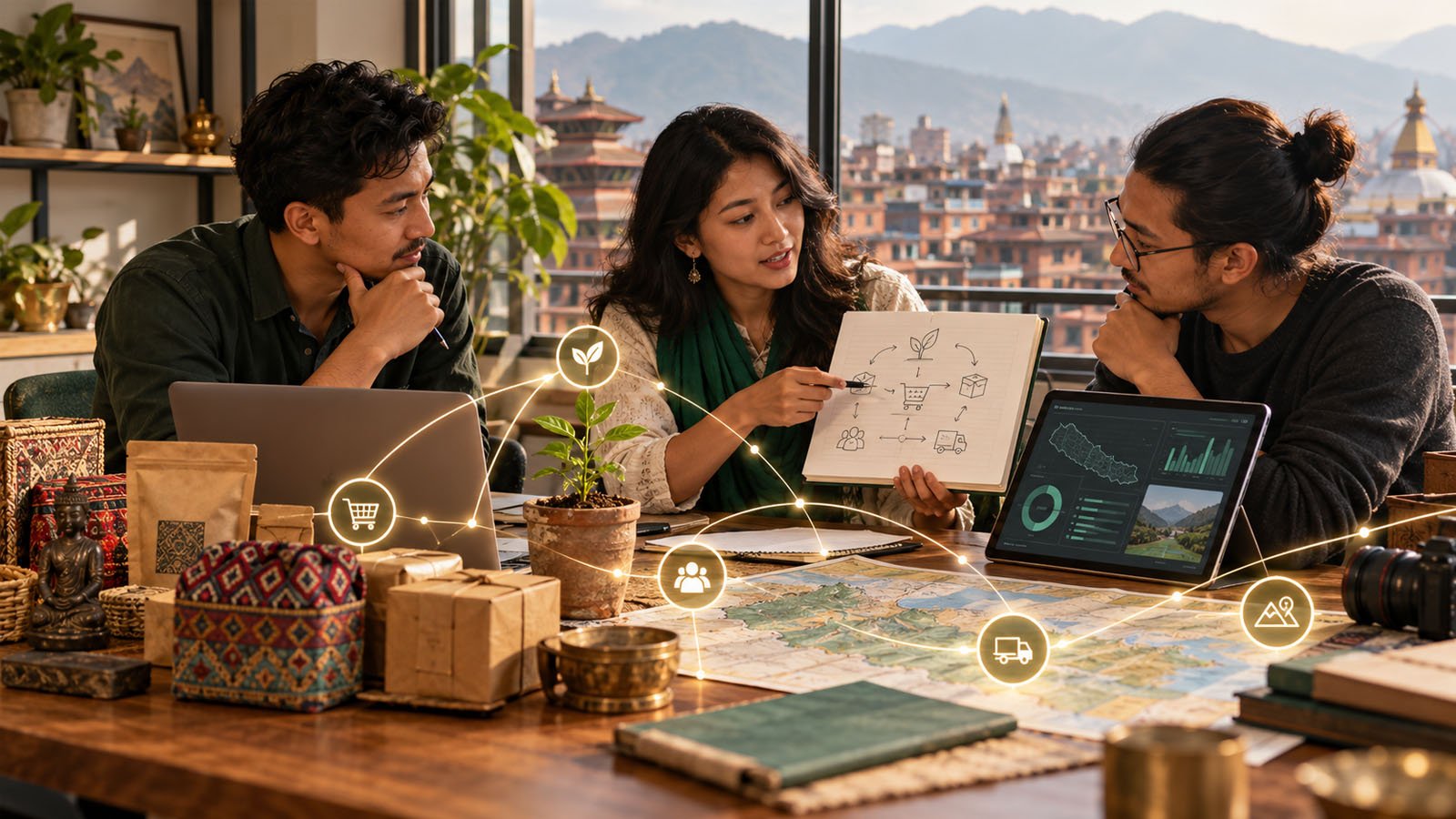
AI-Powered Business Models: The Growth Opportunities Nepal Cannot Afford to Miss
Introduction: A New Economic Architecture Is Emerging
AI-powered business models are opening new possibilities for entrepreneurs, small businesses, and professionals in Nepal. From customer support and marketing to education and e-commerce, AI tools can help teams redesign how they deliver value.
However, adopting technology is only the beginning. A viable business still needs a real customer problem, reliable delivery, and a clear way to earn revenue.
This sixth article in my series, “Future Skills and Opportunities in the Age of AI,” explores five business models and how Nepali entrepreneurs could adapt them to local needs.
1. The Rise of AI-Native Startups
The next generation of startups won’t just use AI — they will be built on AI.
AI-native businesses operate with:
- Minimal staff
- Maximum automation
- Data-driven decision-making
- Global-first scalability
Examples worldwide include:
- AI-driven marketing agencies
- Automated e-commerce platforms
- Virtual influencers
- AI-based customer support systems
- AI-powered SaaS tools built by 1–3 people teams
In Nepal, this opens opportunities for:
- Localized AI content generation
- Nepali-language chatbots for banks, insurance, and government
- AI analytics services for SMEs
- Automated digital marketing studios
Small teams can now compete at a scale previously impossible.
2. AI Agents as the New Workforce
One of the biggest breakthroughs is the rise of autonomous AI agents — systems that act, learn, and improve without constant human supervision.
Example tasks AI agents already perform:
- Managing inboxes and calendars
- Running marketing campaigns
- Handling sales funnels
- Conducting market research
- Writing and deploying code
- Monitoring customer behavior
In the future, a small organization may look like this:
CEO → 5 Human Specialists → 50 AI Agents
This model drastically reduces cost and increases speed, enabling startups in Nepal to compete globally.
3. Five AI-Powered Business Models for Nepal
AI is birthing entire industries that didn’t exist five years ago:
i. AI Consulting & Integration Services
Businesses need help adopting AI — strategy, training, customization, and workflow redesign.
ii. Micro-SaaS Platforms
A single developer can now build tools for:
- Accounting automation
- HR workflows
- Customer support
- Marketing analytics
iii. Creator Economy 2.0
Creators who use AI for:
- Editing
- Scripting
- Designing
- Distribution …can scale content output massively.
iv. Hyper-Personalized E-Commerce
AI generates:
- Personalized product recommendations
- Dynamic pricing
- Automated customer service
- Predictive inventory management
v. EdTech 2.0
AI tutors, virtual classrooms, personalized learning journeys — especially relevant for Nepal’s remote and rural education.
To evaluate AI-powered business models, start with five questions: Who is the customer? What problem are you solving? What will they pay for? How much will delivery cost? Where is human review essential? A convincing demonstration is useful, but repeat customers and sustainable margins are stronger evidence of a viable business.
4. Nepal’s Untapped Opportunities
Nepal can leverage AI in several strategic ways:
Nepali Language AI Products
There is huge demand for:
- Nepali voice assistants
- Chatbots for government services
- Nepali OCR and translation tools
AI-Enhanced Tourism
- Personalized travel itineraries
- Virtual tour guides
- Automated travel support
Agricultural AI Solutions
- Predictive crop analytics
- Soil health assessments
- Weather forecasting tools
- Pest detection AI systems
AI in Healthcare
- Automated medical record systems
- Predictive diagnosis
- Telemedicine AI triage
These are realistic opportunities for Nepali innovators and startups within the next 3–5 years.
5. The Human Shift: From Worker to Creator
As AI automates operational work, human roles will increasingly focus on:
- Creativity
- Leadership
- Strategy
- Ethics
- Relationship-building
The future entrepreneur will not compete with AI — they will collaborate with it.
The fastest-growing businesses of the next decade will be built by humans who understand how to direct intelligent systems.
🧭 Conclusion: A New Frontier for Nepal
Nepal’s opportunity lies in developing AI-powered business models that solve specific problems, work reliably, and earn customer trust. Start small, test demand, and expand when the results justify it.
AI is not taking jobs away. AI is taking tasks away — freeing people to think, innovate, and build.
Nepal’s youth, with their digital fluency and entrepreneurial mindset, are uniquely positioned to lead this transformation. The next five years will decide whether Nepal becomes a consumer of AI technology or a creator of AI-powered solutions.
#AIinNepal #FutureOfWork #ArtificialIntelligence #Entrepreneurship #Innovation #AIBusiness #StartupNepal #DigitalTransformation #FutureSkills #AIEconomy #WorkforceDevelopment
Originally published on LinkedIn on 6 December 2025.
Explore more of my articles on AI, leadership, and workforce development.
You May Also Enjoy Reading

AI-Proof Careers: A Practical Skills and Career Plan
Build career resilience through a task-review worksheet, a worked salesperson example and a 30-day skills-development plan. No career is completely protected from…
Read article
Becoming an AI Generalist: New Opportunities in Nepal
Explore how becoming an AI generalist can help professionals and entrepreneurs in Nepal connect skills, solve problems, and create new opportunities.
Read article
AI-Resilient Careers in Nepal: How Work Is Changing
Which parts of a job may change with AI? Explore evidence from the ILO and World Bank, with illustrative examples across occupations…
Read article
AI Job Replacement Timeline in Nepal: What Evidence Shows
There is no single date when AI will replace jobs in Nepal. Understand the difference between technical capability, business adoption and employment…
Read article